
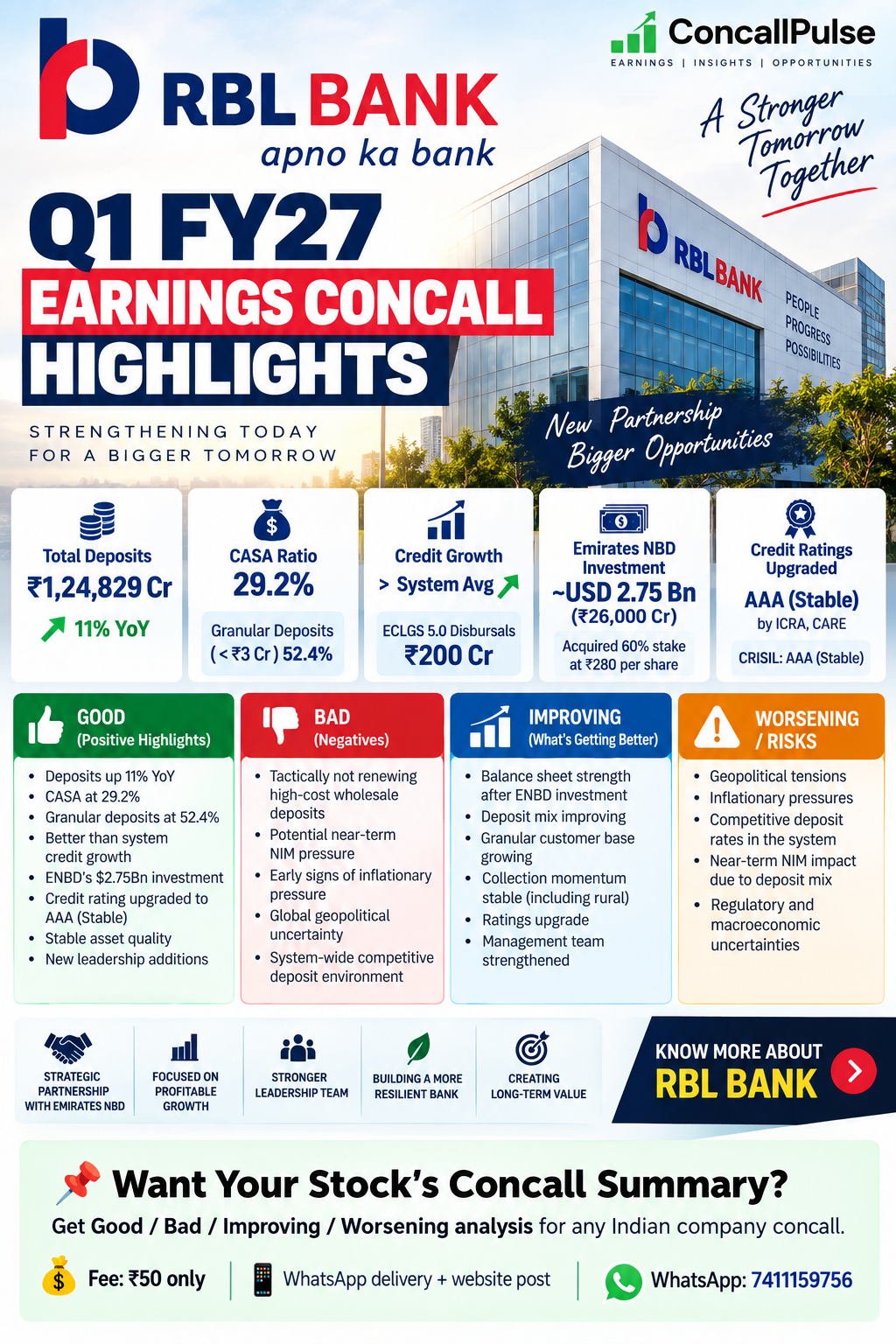
RBL Bank Q1 FY27 Earnings Concall: RBL Bank entered FY27 with a major balance-sheet transformation after Emirates NBD invested approximately ₹26,000 crore through a preferential issue and became the bank’s promoter. The June quarter delivered strong loan growth, improving asset quality outside stressed unsecured segments, and a sharp strengthening of capital ratios. However, elevated credit-card/personal-loan credit costs and near-term NIM pressure remain important watch points.
Concall date: July 17, 2026
Company Profile
RBL Bank Limited is an Indian private-sector bank with businesses spanning retail banking, wholesale banking, credit cards, microfinance, secured retail lending and commercial banking. Management’s current strategy is focused on building a more granular liability franchise, increasing secured retail exposure, expanding corporate relationships and using the strengthened balance sheet to pursue profitable growth.
The bank’s strategic position changed materially during Q1 FY27 after Emirates NBD infused approximately USD 2.75 billion / ₹26,000 crore through a preferential issue at ₹280 per share and acquired 60% of the expanded share capital. Emirates NBD is now classified as a promoter of RBL Bank.
Q1 FY27 Financial Snapshot
| Metric | Q1 FY27 | YoY / Change |
|---|---|---|
| Total Advances | ₹1,16,223 Cr | +23% YoY |
| Total Deposits | ₹1,24,829 Cr | +11% YoY |
| Average Deposits | — | +24% YoY |
| Retail Advances | ₹64,196 Cr | +13% YoY |
| Wholesale Advances | — | +38% YoY |
| NII | ₹1,654 Cr | +12% YoY |
| Other Income | ₹959 Cr | -10% YoY |
| Total Net Income | ₹2,614 Cr | +2% YoY |
| Operating Expenses | ₹1,691 Cr | -8% YoY |
| Net Profit | ₹254 Cr | +27% YoY |
| GNPA | 1.30% | Improved QoQ |
| Net NPA | 0.37% | Improved QoQ |
| Capital Adequacy | 33.3% | Post ENBD infusion |
| CET-1 | 32.2% | Post ENBD infusion |
The bank reported net profit of ₹254 crore compared with ₹200 crore in Q1 FY26. NII increased 12% YoY, while operating expenses declined 8%, helping pre-operating profit rise 31% YoY. 0
ENBD’s ₹26,000 Crore Infusion: The Biggest Strategic Change
Emirates NBD invested approximately USD 2.75 billion or ₹26,000 crore through a preferential issue at ₹280 per share on June 18, 2026. ENBD acquired 60% of the expanded share capital and is now classified as RBL Bank’s promoter.
Management said around ₹10,000 crore of the capital had already been used to retire borrowings and high-cost deposits, with the retired liabilities carrying a net rate of approximately 7.25%. The remaining funds were invested in short-term market instruments and can subsequently be deployed into loans as credit growth absorbs the excess liquidity.
This gives RBL Bank a significant balance-sheet cushion while management works on lowering the cost of liabilities and expanding its loan book.
Management Commentary
1. Loan Growth Remains Strong
Advances grew 23% YoY to ₹1,16,223 crore, ahead of the banking system’s approximately 19% credit growth during the quarter.
- Secured retail advances: +18% YoY
- Unsecured retail advances: +8% YoY
- Wholesale advances: +38% YoY
- Large corporate: +38% YoY
- Commercial Banking: +36% YoY
- JLG disbursements: +50% YoY
- Secured business loans: +48% YoY
Management wants future retail growth to become more balanced, with faster growth in secured businesses such as business loans, housing loans and gold loans. 1
2. Deposits: Strategic Reset Rather Than Abandonment
Total deposits grew 11% YoY to ₹1,24,829 crore, while average deposits increased 24% YoY. Granular deposits below ₹3 crore accounted for 52.4% of total deposits.
However, RBL Bank deliberately did not renew certain high-cost wholesale deposits after the ENBD capital infusion. Management emphasized that the bank remains active in the deposit market, particularly retail deposits, while becoming more selective on pricing.
Management indicated that retail deposits are targeted to grow in the 20%+ range, broadly 23%-24%, with FCNR deposits providing an additional opportunity. 2
3. ENBD Creates an FCNR and NRE Opportunity
One of the most interesting strategic opportunities is access to Emirates NBD’s Middle East franchise.
Management said RBL Bank currently has roughly 0.5% deposit market share and aims for its FCNR share to reach roughly 2-3x its current market share, with management subsequently clarifying an aspiration around 1.5%-2% of FCNR deposits.
The bank also sees a significant opportunity in NRE deposits, remittances and customer relationships involving Indians in the Middle East.
Net Interest Margin: Near-Term Pressure, Then Recovery?
RBL Bank’s NIM stood at approximately 4.13%, with management acknowledging pressure over the last two quarters.
The key reasons included:
- Lagged impact of earlier repo-rate cuts.
- Higher-cost savings-account deposits introduced in late March.
- Credit-card reversals.
- Changes in the liability mix.
- Higher wholesale exposure.
The positive factor is the substantial equity infusion. Management expects a 30-40 bps improvement in NIM in Q2 FY27 from the capital-related base effect and expects margins to continue improving directionally over the following 3-6 months.
However, management does not want to chase a particular NIM number. Instead, the focus is on improving ROA and ROE through lower liability costs, better asset mix and controlled provisioning. 3
Asset Quality: Improving Overall, But Credit Cards Remain the Key Risk
Overall reported asset quality improved:
- GNPA: 1.30%, down 15 bps QoQ
- Net NPA: 0.37%, down 2 bps QoQ
- PCR: 72%
- Credit cost: 54 bps
However, credit-card and personal-loan credit costs remain elevated. Management said headline credit costs for the cards plus personal-loan book had been around 11%-12% in recent quarters.
The company expects some reduction in Q2, followed by a material reduction from Q3 FY27, with credit costs expected to move toward the 5% range by Q3.
Management’s confidence is based on improvement in early delinquency buckets, particularly 10-day and 30-day flows, after actions around sourcing and collections. 4
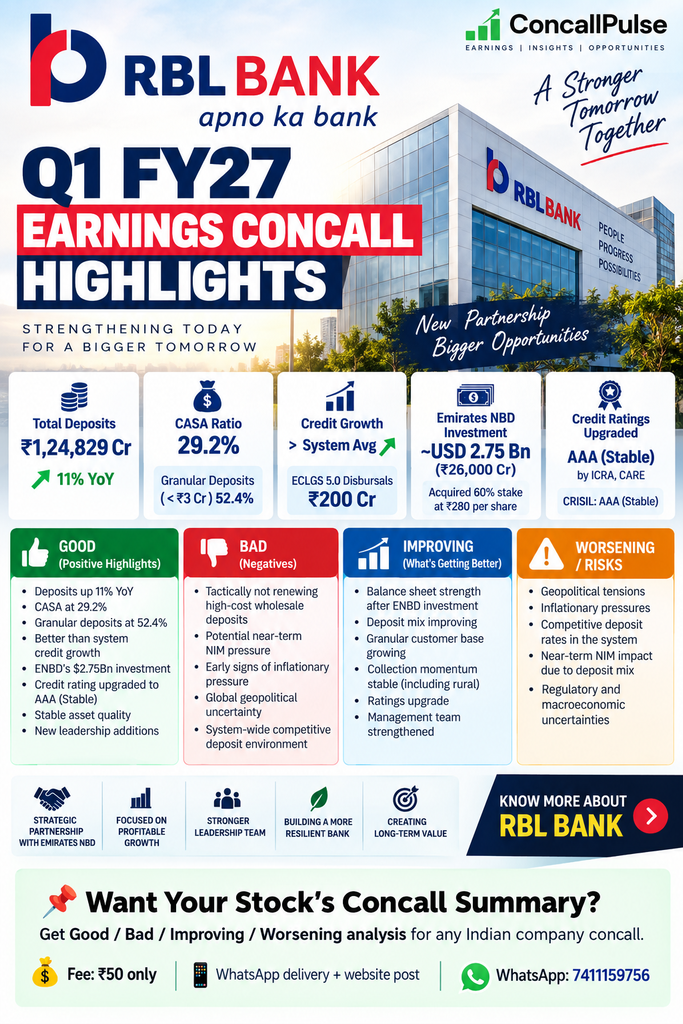
GOOD — Positive Highlights
- 23% YoY loan growth, ahead of banking-system credit growth.
- ₹26,000 Cr ENBD capital infusion dramatically strengthens the balance sheet.
- Capital adequacy at 33.3% and CET-1 at 32.2%.
- Wholesale advances growing strongly at 38% YoY.
- Secured business loans growing 48% YoY.
- Deposits below ₹3 crore form 52.4% of deposits.
- AAA Stable ratings from ICRA, CARE and CRISIL.
- GNPA and Net NPA improved QoQ.
- Operating expenses declined 8% YoY.
- Net profit increased 27% YoY to ₹254 Cr.
- ENBD relationship opens FCNR, NRE, remittance and corporate-banking opportunities.
BAD — Negative Points
- Credit-card/personal-loan credit costs remain elevated.
- Other income declined 10% YoY because of lower treasury income.
- CASA remains a pressure point, with daily average CASA around 25%-26%.
- Near-term NIM remains vulnerable to asset and liability mix changes.
- High-cost wholesale deposits were intentionally reduced, which temporarily affects deposit growth.
- Unsecured retail growth is materially slower than wholesale and secured retail growth.
IMPROVING — What Is Getting Better?
- Early delinquency indicators in cards are improving.
- Management expects a sharp reduction in card slippages from Q3 FY27.
- Cost of liabilities should decline following the ENBD transaction and AAA rating upgrade.
- Secured retail is becoming a larger strategic growth engine.
- Wholesale opportunities are expanding after the rating upgrade.
- Capital strength gives the bank time to rebuild low-cost deposits without aggressively competing on deposit rates.
- Management expects ROA to reach around the 1% zone in Q2-Q3 FY27 and improve further by year-end.
5
WORSENING / RISKS — What Investors Should Watch
- Credit-card stress: the biggest immediate earnings risk.
- NIM uncertainty: management itself does not provide precise longer-term NIM guidance.
- CASA mobilization: lower savings rates could slow organic low-cost deposit growth.
- Geopolitical risk: Middle East tensions could create indirect inflationary and economic pressure.
- Mix transition: increasing secured lending can reduce asset yields even as liability costs improve.
- Execution risk: the ENBD partnership offers significant opportunity, but monetizing FCNR/NRE/remittance and corporate opportunities will take time.
Credit Card Strategy: From Standalone Product to Relationship Engine
RBL Bank is changing how it views credit cards. Management said the product will increasingly be bundled with salary accounts, branch relationships and other banking products rather than being treated purely as a standalone unsecured product.
The bank expects credit cards to grow slower than the overall loan book because the market is already mature. Therefore, the credit-card share of advances should gradually decline even while the business continues to grow.
This could improve the overall risk profile if the faster-growing portions of the portfolio are secured and relationship-led.
Cost-to-Income: Operating Leverage Opportunity
Cost-to-income improved to approximately 64.7% from 65.1% in the previous quarter.
Management expects the capital infusion and resulting interest-income growth to create further operating leverage, potentially reducing the cost-to-income ratio by another 5-6 percentage points over the next one or two quarters.
The bank also expects technology, automation and productivity improvements to support branch expansion without a proportionate increase in employee costs.
Capital & Balance Sheet Outlook
The ENBD investment gives RBL Bank unusually high capital buffers. Management’s immediate priority is not aggressive deployment at any cost but disciplined deployment into attractive opportunities.
The bank intends to:
- Reduce expensive liabilities.
- Gradually deploy excess liquidity into loans.
- Increase secured retail exposure.
- Expand higher-quality wholesale relationships.
- Build retail deposits at competitive but more disciplined rates.
- Leverage ENBD for FCNR/NRE and cross-border opportunities.
The management repeatedly emphasized that it does not intend to take outsized credit risk simply to accelerate growth.
ROA & ROE Outlook
Rather than targeting a specific NIM, management is focused on profitability metrics.
The company expects ROA to reach the 1% zone around Q2-Q3 FY27, with further improvement as credit-card credit costs normalize in Q3 and Q4.
For ROE, management has set an aspirational objective of reaching double-digit ROE within 3-4 years, potentially sooner if operating conditions improve.
PSL & Microfinance
RBL Bank expects microfinance, tractors and agriculture-related lending to provide roughly 10% of its loan book and said microfinance provisioning is increasingly covered by CGFMU.
Management expects to meet its PSL obligations without taking unnecessary credit risk merely to satisfy regulatory requirements. PSLC remains an available tool where required.
Macro & Sector View
Management described demand conditions across key customer segments as broadly stable. Retail consumption and small-business activity are continuing broadly in line with recent trends.
The bank has not seen a material portfolio impact from the Middle East conflict so far, although it remains watchful for inflationary pressure.
Management also noted that banking-system deposits grew around 13% YoY while system credit growth was approximately 19%. RBL Bank’s 23% advance growth therefore remains ahead of the system.
Competitive Positioning
RBL Bank’s competitive advantage is increasingly shifting from simply being a mid-sized bank toward having:
- A significantly stronger capital base.
- AAA credit ratings.
- Access to Emirates NBD’s international ecosystem.
- Potential FCNR/NRE/remittance opportunities.
- Growing secured retail capabilities.
- Strong corporate and commercial-banking growth.
- Ability to price loans more competitively because of lower expected liability costs.
The key question is whether RBL Bank can convert this balance-sheet advantage into sustainable low-cost deposits, profitable credit growth and lower credit costs.
Four Key Growth Drivers Ahead
1. ENBD Synergies
FCNR, NRE, remittance and corporate relationships could become important incremental growth engines.
2. Lower Cost of Funds
AAA ratings and the reduction of expensive deposits and borrowings should improve the liability side of the P&L.
3. Secured Retail Growth
Business loans, housing loans and gold loans are expected to grow faster as the bank seeks a more balanced asset mix.
4. Credit-Cost Normalization
If card and personal-loan slippages decline materially from Q3 FY27 as management expects, earnings could receive a meaningful boost.
What Changed This Quarter?
| Earlier Position | Q1 FY27 Direction |
|---|---|
| Capital constraints | Massive ₹26,000 Cr ENBD infusion |
| Higher-cost liabilities | ₹10,000 Cr of expensive liabilities retired |
| Lower credit rating | AAA Stable ratings |
| Unsecured-heavy growth concerns | Greater focus on secured retail |
| Credit-card stress | Early delinquency indicators improving |
| Limited international reach | Potential ENBD-led Middle East opportunity |
Analyst Takeaway
RBL Bank’s Q1 FY27 story is less about the ₹254 crore quarterly profit and more about the transformation of its balance sheet.
The ₹26,000 crore Emirates NBD investment gives the bank a rare combination of capital strength, improved ratings and access to a large international banking ecosystem. The next phase is about converting that advantage into lower funding costs and sustainable profitable growth.
The biggest near-term uncertainty remains credit-card and personal-loan credit costs. Management expects a meaningful improvement from Q3 FY27. If that happens alongside the expected 30-40 bps Q2 NIM improvement, RBL Bank’s earnings profile could improve substantially through the second half of FY27.
The key investor checklist is therefore:
- Card slippages from Q2 to Q3.
- NIM trajectory after the capital infusion.
- CASA and granular deposit growth.
- FCNR/NRE deposit traction.
- Secured retail mix.
- Credit cost normalization.
- ROA progression toward and beyond 1%.
Investor-Friendly Verdict Card
RBL Bank Q1 FY27 Verdict
Growth: 🟢 Strong
Balance Sheet: 🟢 Significantly Strengthened
Asset Quality: 🟡 Improving, but cards remain a concern
NIM: 🟡 Near-term pressure, recovery expected
Capital: 🟢 Excellent
Deposit Franchise: 🟡 Key execution area
ENBD Synergy: 🟢 Major long-term opportunity
Overall View: 🟢 Strategic transformation story with near-term credit-cost risks
📌 Want Your Stock’s Concall Summary?
Get Good / Bad / Improving / Worsening Analysis
Get a detailed Good / Bad / Improving / Worsening analysis for any Indian company concall.
- 💰 Fee: ₹50 only
- 📱 WhatsApp delivery + website post
- 📞 WhatsApp: 7411159756
Want your company’s concall decoded in a simple investor-friendly format? Get in touch with ConcallPulse.
Frequently Asked Questions
What was RBL Bank’s loan growth in Q1 FY27?
RBL Bank’s advances grew 23% YoY to ₹1,16,223 crore.
How much did Emirates NBD invest in RBL Bank?
Emirates NBD infused approximately ₹26,000 crore, or USD 2.75 billion, through a preferential issue and acquired 60% of the expanded share capital.
What was RBL Bank’s Q1 FY27 net profit?
Net profit increased 27% YoY to ₹254 crore from ₹200 crore in Q1 FY26.
What was RBL Bank’s GNPA and Net NPA?
GNPA was 1.30% and Net NPA was 0.37% at the end of Q1 FY27.
What is the biggest risk for RBL Bank?
The biggest near-term risk is elevated credit costs and slippages in the credit-card and personal-loan portfolio.
When does management expect credit-card credit costs to improve?
Management expects some improvement in Q2 FY27 and a material reduction from Q3 FY27, with credit costs expected to move toward the 5% range by Q3.
What is RBL Bank’s NIM outlook?
Management expects a 30-40 bps improvement in Q2 FY27 from the capital-related base effect and expects margins to improve directionally over the following 3-6 months.
What is RBL Bank’s ROA outlook?
Management expects ROA to reach around the 1% zone in Q2-Q3 FY27 and improve further by the end of FY27.
What is RBL Bank’s long-term ROE aspiration?
Management has an aspirational objective of reaching double-digit ROE within 3-4 years, potentially sooner depending on execution and operating conditions.
Useful Links
Source: RBL Bank Limited Q1 FY27 Earnings Conference Call transcript dated July 17, 2026. 6
Disclaimer: This article is an analytical summary of management commentary and reported information. It is for educational and informational purposes only and should not be considered investment advice.