
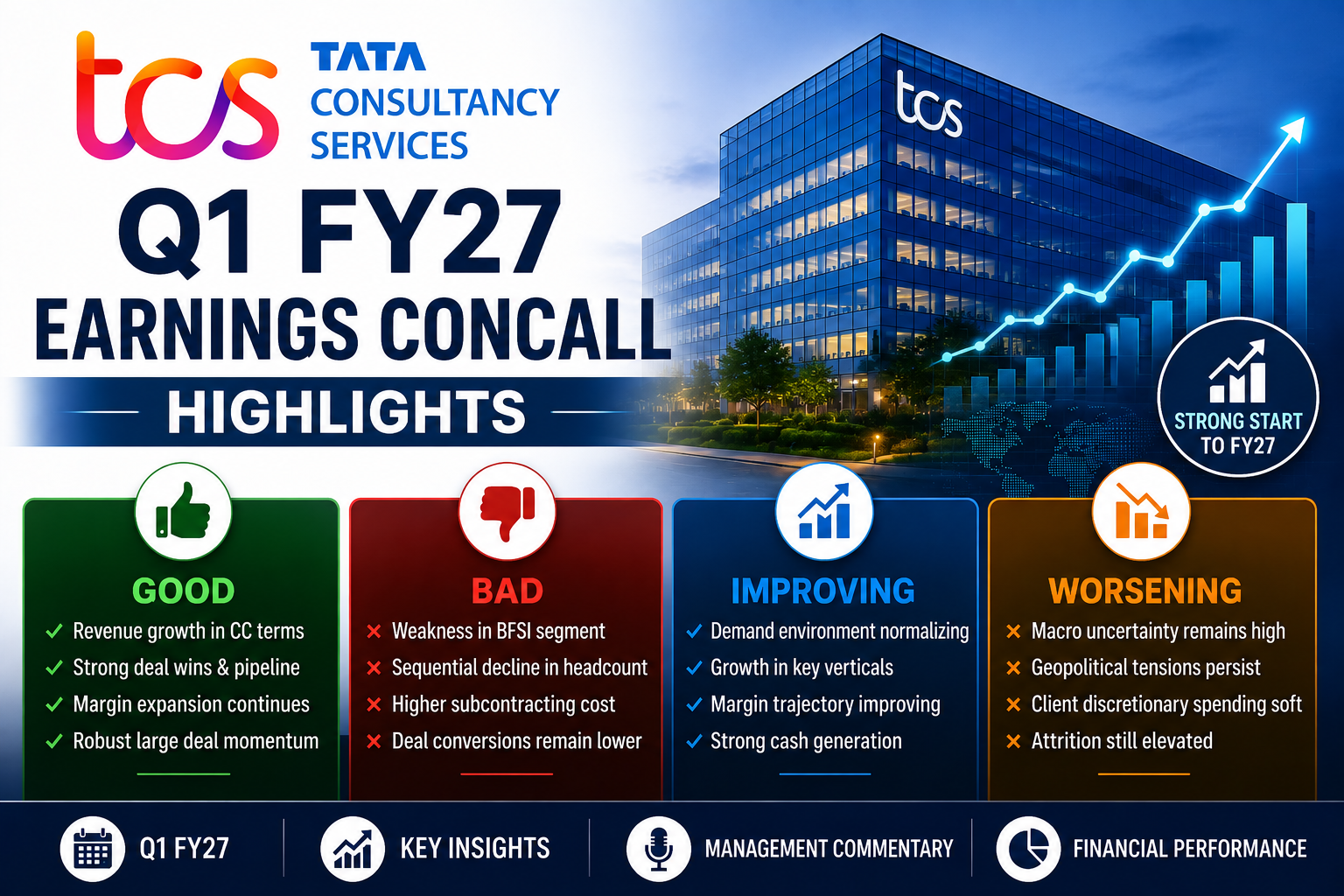
TCS Q1 FY27 earnings concall highlights showcase how Tata Consultancy Services continues to strengthen its leadership in global IT services through large transformation deals, AI-led innovation and deep customer relationships. TCS remains one of the world’s largest IT services companies, offering consulting, cloud transformation, AI, engineering, cybersecurity and digital solutions across banking, manufacturing, healthcare, retail, telecom, energy and public services.
During Q1 FY27, management highlighted continued client investments in AI transformation, cloud modernization and operational efficiency despite an uncertain global macro environment. The company also emphasized disciplined execution, strong customer retention and sustained investment in talent and innovation. 0
Management Commentary (Key Messages)
The TCS Q1 FY27 earnings concall highlights reflected management’s confidence that AI adoption has now moved beyond experimentation into enterprise-wide deployment. Leadership highlighted record client engagement across Generative AI, strong deal pipeline, healthy execution discipline and resilient operating performance despite continued macro uncertainty in some verticals and geographies. 1
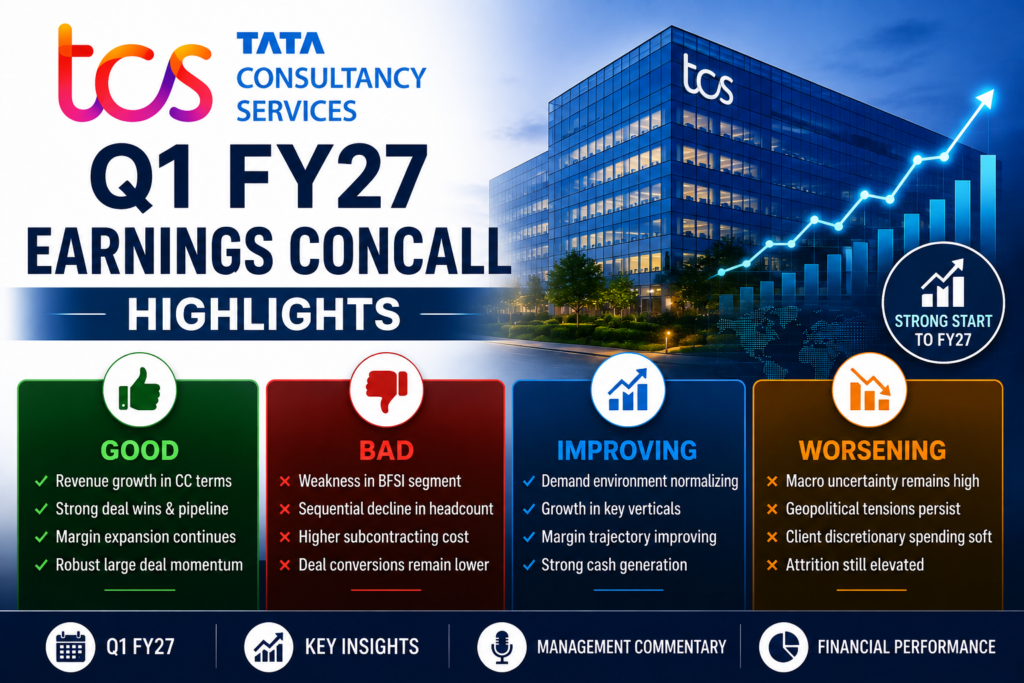
Management noted that AI is becoming an integral part of every transformation program. Clients increasingly seek measurable productivity gains while simultaneously investing in modernization, cloud migration and platform engineering. TCS believes its deep domain expertise and execution capability position it well to benefit from this structural technology shift. 2
The company also emphasized that customer relationships remain strong, employee capability building continues at scale and execution quality remains one of its key competitive differentiators. 3
Financial Snapshot (Quarter)
- Revenue: ₹72,275 Cr
- Operating Margin: 24.0%
- Net Margin: 19.2%
- Annualized AI Revenue: Approximately US$2.6 Billion
- Total Contract Value (TCV): US$9.5 Billion
- Large Deal Pipeline: Remains healthy across industries
- Cash Generation: Strong operating cash flow maintained
The company maintained healthy profitability while continuing investments in AI capabilities, delivery infrastructure and employee upskilling. 4
TCS Q1 FY27 earnings concall highlights: What Changed This Quarter?
The biggest change during the quarter was the rapid acceleration of enterprise AI adoption. Management indicated that Generative AI has become embedded across multiple client transformation programs rather than remaining a standalone initiative. Large transformation deals increasingly include AI, cloud modernization and automation components, creating a broader opportunity pipeline for TCS. The TCS Q1 FY27 earnings concall highlights also reflected resilient profitability despite cautious discretionary spending in certain sectors. 5
✅ GOOD (Positive Highlights)
- Revenue remained strong at ₹72,275 Cr.
- Operating margin sustained at 24% despite continued investments.
- Net margin remained healthy at 19.2%.
- Annualized AI business reached approximately US$2.6 Billion.
- Total Contract Value (TCV) remained robust at US$9.5 Billion.
- Enterprise AI adoption accelerated across global clients.
- Large transformation deal pipeline stayed healthy.
- Cloud modernization demand remained strong.
- Customer relationships remained resilient.
- Strong execution capabilities continued to differentiate TCS.
- Cash generation remained healthy.
- Employee capability building in AI continued at scale.
- Cross-selling opportunities improved across verticals.
- Management maintained confidence in long-term technology spending trends.
❌ BAD (Negatives)
- Macroeconomic uncertainty continues to impact discretionary spending in certain sectors.
- Decision-making cycles remain longer for some enterprise customers.
- Pricing pressure persists in selected competitive deals.
- Some industries continue to remain cautious regarding new technology budgets.
- Global economic uncertainty continues to influence customer spending behaviour.
📈 IMPROVING (What is Getting Better)
- Enterprise AI adoption is expanding rapidly.
- AI has moved beyond pilots into production deployments.
- Cloud transformation demand remains healthy.
- Large deal pipeline continues to strengthen.
- AI-led productivity programs are gaining customer acceptance.
- Cross-industry digital transformation opportunities continue expanding.
- Customer engagement around innovation continues to improve.
- Talent capability in AI continues to scale rapidly.
📉 WORSENING / RISKS
- Global macro uncertainty remains elevated.
- Clients continue to optimize technology budgets.
- Longer sales cycles may delay project conversions.
- Competitive intensity remains high across global IT services.
- Currency fluctuations could impact reported financial performance.
- Rapid AI evolution requires continuous investments.
- Hiring and wage inflation remain medium-term considerations.
Outlook & Guidance (What Mgmt Said Next)
Management reiterated that while macroeconomic and geopolitical uncertainties remain, the long-term technology spending cycle remains intact. Customer conversations continue to indicate healthy demand for AI-led transformation, cloud modernization, cybersecurity, sovereign cloud, platform rationalization and vendor consolidation. TCS believes these priorities will continue driving enterprise technology investments over the coming years. 0
- Management expects demand to gradually improve during Q2 as deferred technology projects resume. 1
- AI transformation continues to be the largest structural growth opportunity.
- Large deal pipeline remains healthy with continued momentum in mega deals.
- Investment priorities remain focused on AI capabilities, partnerships, platforms, domain solutions and talent transformation. 2
- Management remains committed to maintaining industry-leading profitability while continuing strategic investments for long-term competitiveness. 3
- Capital allocation policy remains unchanged with continued focus on returning substantial free cash flow to shareholders while investing for future growth. 4
Macro & Sector View
The management commentary suggests that enterprise technology spending remains resilient despite ongoing geopolitical tensions and macroeconomic uncertainty. Customers are becoming increasingly selective, prioritizing projects that improve productivity, resilience, cybersecurity and AI readiness rather than discretionary digital initiatives.
- BFSI: Continues to remain one of the strongest growth verticals globally.
- Technology & Software: Strong momentum supported by AI-led modernization projects and new platform implementations. 7
- Manufacturing: Near-term softness due to automotive weakness, tariff concerns and macro uncertainty, although management remains optimistic because of strong AI transformation wins. 8
- Consumer Business: Continues to face pressure from inflation, geopolitical uncertainty and weak discretionary spending, particularly in airlines and non-essential retail.
- Life Sciences: Short-term weakness, but management expects recovery supported by AI, automation and compliance-related investments.
- Regional Markets: India, Public Services and Products & Platforms continue to remain important growth drivers. 11
Competitive Positioning (Why it May Win)
- Industry-leading AI transformation capabilities.
- Annualized AI services revenue exceeding US$2.6 Billion demonstrates strong monetization capability. 12
- Healthy mega deal pipeline including US$800 million SKF transformation program. 13
- Strong partnerships with Anthropic and Mistral AI strengthen AI ecosystem leadership. 14
- Infrastructure to Intelligence strategy differentiates TCS from traditional IT service providers. 15
- Strong delivery capabilities across cloud, cybersecurity, AI governance and platform modernization.
- One of the industry’s largest learning ecosystems supporting continuous AI upskilling. Associates completed 14.6 million learning hours and added over 1.3 million competencies during Q1. 16
- Strong client mining and diversified industry exposure reduce concentration risk.
Key Growth Drivers Going Ahead
- Enterprise-wide AI transformation.
- Agentic AI adoption across business processes.
- Infrastructure modernization.
- Cloud migration and sovereign cloud demand.
- Cybersecurity transformation.
- Platform rationalization.
- Vendor consolidation opportunities.
- Large AI-led transformation programs.
- AI governance and lifecycle management solutions.
- Forward Deployment Engineer (FDE) operating model evolution for enterprise AI delivery.
- Expansion of AI-native consulting and business transformation engagements.
Analyst Takeaway / Final Verdict
The TCS Q1 FY27 earnings concall highlights reinforce that the company is successfully transitioning from a traditional IT services provider into an AI-led technology transformation partner. Revenue growth remained healthy, margins stayed among the best in the global IT industry despite wage hikes, and AI services revenue continued scaling rapidly. Management repeatedly emphasized that enterprise AI adoption is accelerating beyond pilots into production-scale deployments across industries.
While near-term macro uncertainties and geopolitical tensions continue to delay some discretionary spending, TCS believes the underlying technology demand remains intact. Strong TCV of US$9.5 billion, growing AI monetization, expanding partnerships with leading AI companies and multiple mega transformation wins provide strong long-term revenue visibility.
Management also rejected the view that AI will materially reduce white-collar employment. Instead, the company expects workforce roles to evolve toward AI engineering, model operations, prompt engineering and lifecycle management while continuing investments in hiring and upskilling. 21
Overall, the TCS Q1 FY27 earnings concall highlights indicate that TCS remains well positioned to benefit from the next multi-year AI transformation cycle, supported by strong execution capabilities, healthy deal wins, disciplined capital allocation and continued investments in technology leadership.
Verdict Card (Investor-Friendly)
- Revenue Growth: ⭐⭐⭐⭐⭐ Strong
- AI Business: ⭐⭐⭐⭐⭐ Fast Growing
- Large Deal Pipeline: ⭐⭐⭐⭐⭐ Excellent
- Operating Margin: ⭐⭐⭐⭐☆ Healthy despite wage hikes
- Cash Generation: ⭐⭐⭐⭐⭐ Strong
- Balance Sheet: ⭐⭐⭐⭐⭐ Excellent
- Execution Quality: ⭐⭐⭐⭐⭐ Industry Leading
- Near-Term Risk: Geopolitical uncertainty and slower discretionary spending
- Long-Term Outlook: Highly Positive
- Overall View: AI-led structural growth story remains firmly intact.
FAQ
What are TCS Q1 FY27 earnings concall highlights?
TCS Q1 FY27 earnings concall highlights include revenue of ₹72,275 crore, operating margin of 24%, net margin of 19.2%, annualized AI services revenue of US$2.6 billion, TCV of US$9.5 billion, multiple AI-led mega deal wins, continued investments in AI capabilities, and management’s confidence that enterprise AI adoption will drive long-term growth despite macro uncertainties. 0
Why is AI becoming the biggest growth driver for TCS?
Management stated that enterprise AI has moved beyond experimentation into production deployments across IT operations, software engineering, business process transformation, modernization and enterprise platforms. Customers increasingly seek measurable productivity improvements, stronger governance and faster business transformation using AI.
What is driving TCS’s strong deal pipeline?
The company continues to benefit from large AI-led transformation programs, cloud modernization, cybersecurity initiatives, vendor consolidation and infrastructure modernization. Management highlighted several major deal wins including the US$800 million SKF transformation program and strategic partnerships with global enterprises.
Why did TCS margins decline during the quarter?
Operating margin declined sequentially primarily because of annual wage hikes. Management indicated that continued investments in AI capabilities, talent, partnerships and go-to-market initiatives remain strategic priorities and are expected to strengthen long-term competitiveness.
What are the key risks investors should monitor?
Investors should closely monitor geopolitical developments, discretionary technology spending, project deferrals, currency fluctuations, competitive pricing, AI investment requirements and the pace of enterprise technology spending recovery. Management nevertheless remains optimistic that technology demand will improve as deferred projects resume and AI adoption accelerates.
Useful Links
Internal Links (ConcallPulse)
- Latest Earnings Concall Highlights
- All Earnings Concall Summaries
- Search Any Company Concall (Click & Search)
External Links
🚀 TCS Q1 FY27 earnings concall highlights